
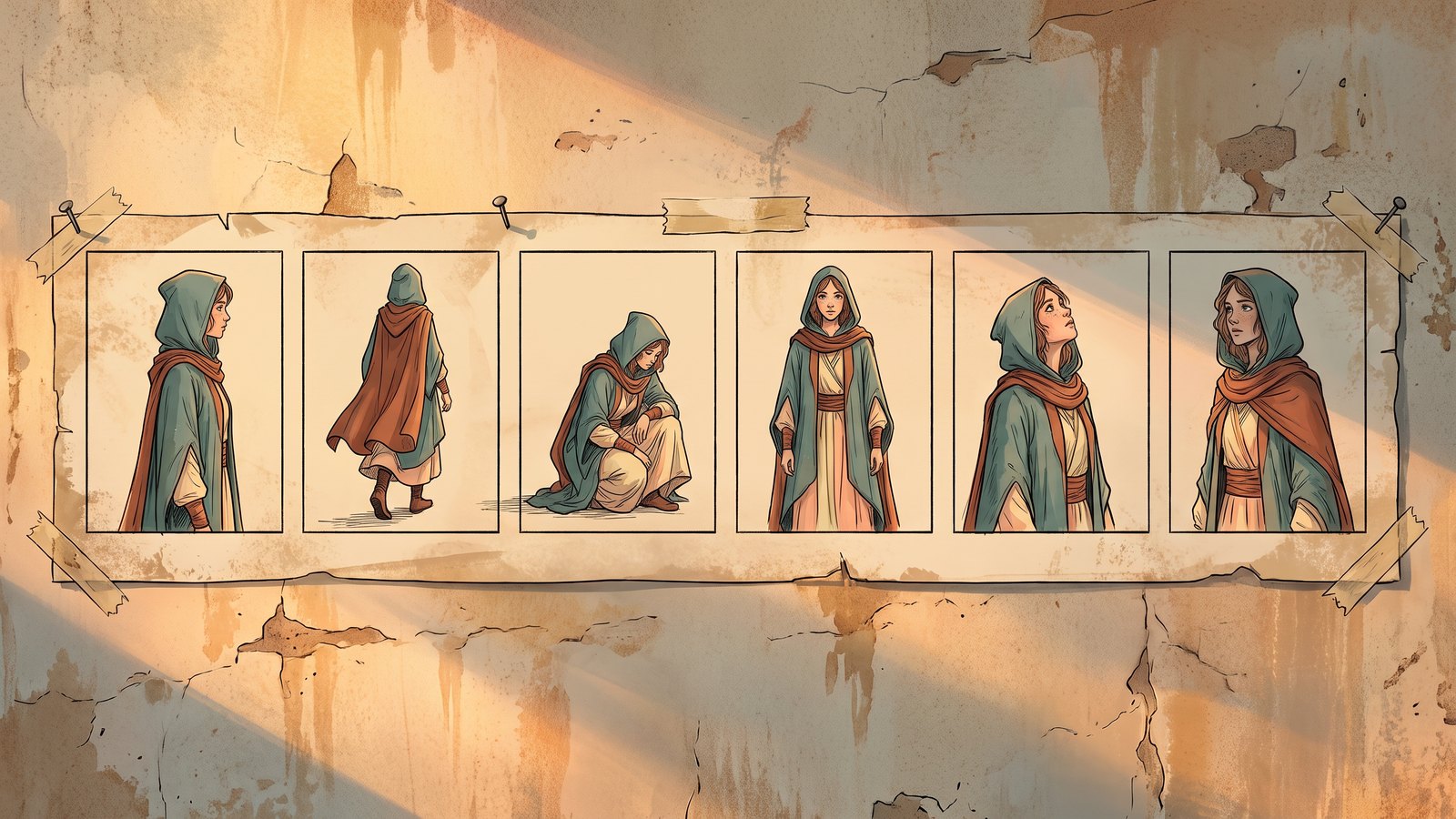
Character Consistency in AI Images: Keeping One Character Across a Whole Campaign
You built a character for your brand. She looked perfect in the first image.
So you went to make image number two. Same idea, new scene. And she came back with a different nose, shorter hair, and a face that belongs to someone else’s brand.
By image six you don’t have a character anymore. You have a lineup of five strangers who happen to own the same jacket.
I see this constantly. Someone falls in love with one image, tries to build a whole campaign around it, and gives up three renders in because the person keeps changing. Then they decide AI just can’t do consistent characters.
It can. Consistency just never comes from the tool on its own. You carry it in with you, every single time.
Here’s the part that explains almost every failed character set: image models don’t remember. Every generation starts from zero. There’s no running memory of what you made an hour ago, no file cabinet where your character lives. If you don’t feed the same identity back in, you get a fresh interpretation of a vague description. And “a friendly woman with brown hair” is a vague description. There are a billion of those.
So the first thing that holds a character together is a written character sheet.
Open a doc. Write your character down in locked descriptors and never paraphrase them again. Age range. Face shape. Eye color and eye shape. Hair color, length, texture, and how it’s worn. Skin tone. Build. One distinguishing feature that’s easy for the model to hit, like a freckled nose, a wide gap smile, or a streak of color in her hair.
Then copy and paste that block into every prompt, word for word, in the same order.
Same words. Same order. Every time.
That last part matters more than people expect. Rewording your description each time is the same as describing a different person. “Shoulder-length auburn waves” and “medium red wavy hair” read as two different women. Pick your phrasing once and stop editing it.
Next, choose your anchor.
Generate a batch of twelve or so from that character sheet and pick the single image that feels most like her. That one becomes your source of truth for the entire campaign. Skip past your favorite pose and the prettiest lighting. Choose the one where the face is most clearly the face you want to repeat.
Save it. Name it something obvious like brandcharacter-anchor. You’ll come back to it constantly.
In Midjourney, you upload that anchor artwork directly into the prompt box as your style reference and write your scene alongside it. The upload does the work. You don’t need to hunt down a link or paste an image address anywhere.
Then comes the discipline part, and it’s where most campaigns fall apart.
Change one variable at a time.
If you swap the pose, the outfit, the art style, the camera distance, and the lighting all in the same prompt, you’ve changed so much that the model has almost nothing to hold onto. The face drifts because everything else moved. Lock the identity block and the wardrobe, then change only the scene. Get that working across three or four images. Then, and only then, start varying the lighting or the angle.
Consistency is a control problem before it’s a creativity problem.
Wardrobe deserves its own attention, because it does more work than your prompt does. People recognize silhouette and color long before they process facial detail. Scrolling on a phone, your audience sees a shape and a color first. Give your character a signature: a specific jacket, a signature color, glasses, a bag, a scarf. Keep that element identical across the set.
I’ve watched sets where the face wasn’t perfectly identical across every frame, but the red jacket and the shoulder-length silhouette carried the recognition anyway. Nobody noticed the face drift. They just saw her.
Then lock your style DNA around her. Same rendering style. Same color system. Same lighting logic. Same rules for camera distance. A character in a soft watercolor scene and the same character in a hard-edged comic scene read as two different characters, even with an identical face, because the visual world around her changed the rules.
One more habit that saves hours: plan the whole set before you generate anything.
Write the shot list first. Twelve scenes for the campaign. Hero image, teaching image, behind-the-scenes image, offer image, testimonial background, seasonal variant, and so on. Then generate them all in one sitting, in one session, working from the same anchor and the same character block.
Batches beat one-offs every time. When you come back three weeks later and try to add “just one more image,” that’s usually when the drift shows up, because your process has gone cold and your phrasing has quietly changed.
Finish with an audit, and do it small. Drop the whole set into a grid and look at it on your phone at thumbnail size, the way your audience will actually see it. Not zoomed in on the eyes. If a stranger scrolling past can tell it’s the same person at that size, you’re done. If two images feel like cousins instead of the same woman, regenerate those two from the anchor rather than trying to fix the whole set.
Then file it properly. A folder with the anchor image, the character sheet doc, the exact prompt structure that worked, and the final approved set. Future you will need it in about six weeks, and future you won’t remember any of it.
Consistent characters come out of a production system rather than a lucky render: a written identity, an anchor image, one variable at a time, a locked wardrobe, and a final audit at the size people actually view your work.
Build that system once and your character stops being a gamble. She becomes an asset you can pull off the shelf for every launch, every email header, every ad, every post, looking like herself the whole way through.
Pick one character this week. Write the sheet. Generate the anchor. Then make three images from it and see how much steadier she is.
Just move. The system gets easier the second time.
Character consistency matters most when you’re building a set, not a single post. Carousels, Reels and Stories walks through building whole campaigns where every piece belongs to the same world.
