
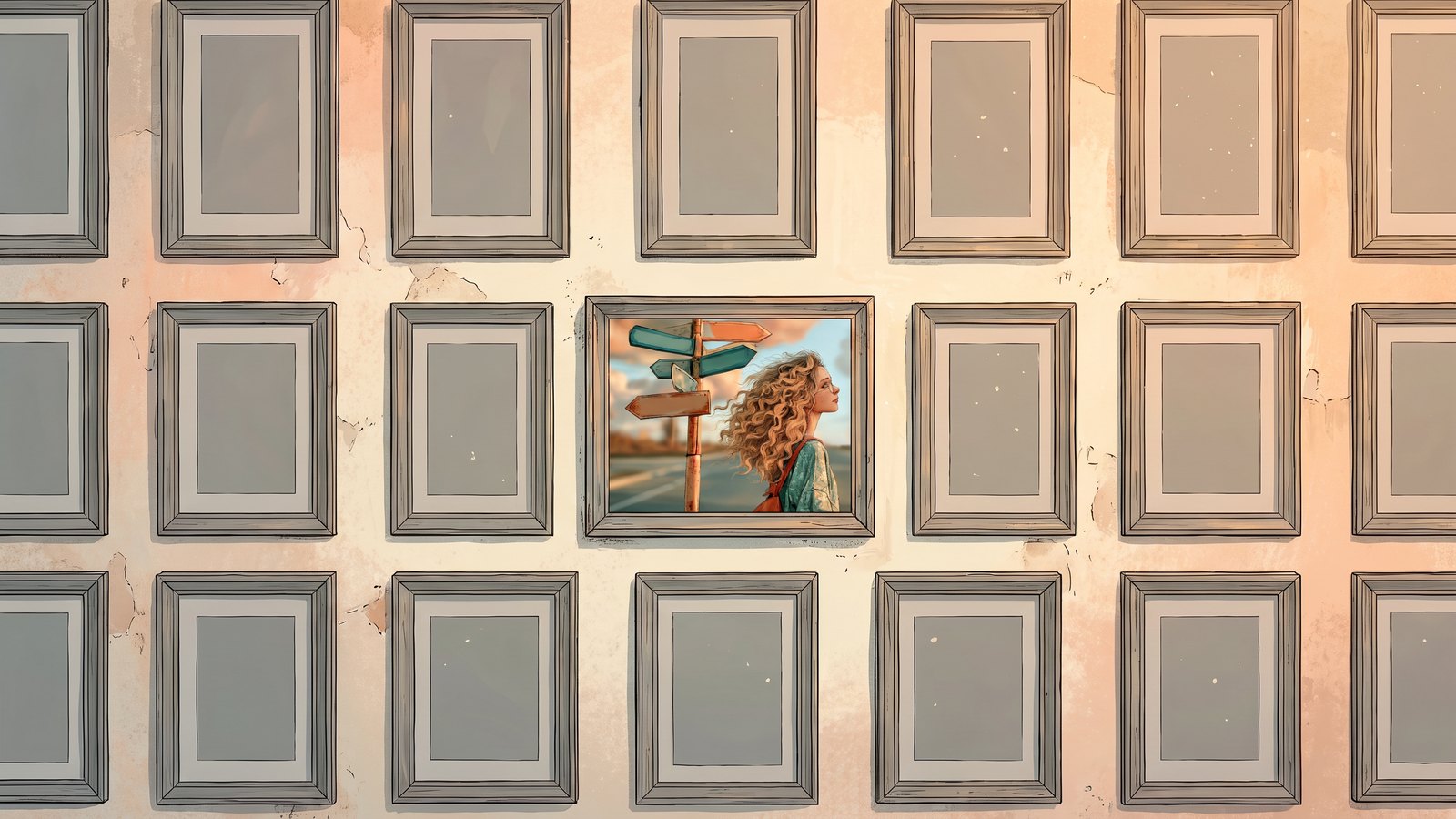
Safe Images Get Scrolled Past: How to Find an Unexpected Visual Angle
You wrote a good post. You really did. It took twenty minutes and it says something true.
Then you needed an image, so you made the obvious one. A person at a laptop looking pleased. A lightbulb. A rising arrow. A tidy desk with a plant.
And the post did nothing.
Here’s what happened in that half second before anybody read a word. Your reader’s brain saw the image, matched it to the ten thousand nearly identical images it has already filed away, and marked it as nothing new. Not offensive. Not ugly. Just already known.
Recognition and attention aren’t the same thing. An image people instantly recognize is an image people instantly dismiss.
The images that stop a scroll are the ones the brain can’t file. There’s a tiny hitch, a half second of “wait, what is that,” and in that hitch your words get read.
So the job isn’t making prettier images. It’s making unfileable ones.
Start with a rule I use constantly: name the obvious image, then ban it.
Before you prompt anything, write down the first picture that came to mind. Woman at laptop. Handshake. Cluttered desk. Whatever it is, write it, then draw a line through it. That first idea isn’t bad, it’s just the same idea everybody else’s brain also produced, because we’ve all been trained by the same decade of stock imagery.
Your second and third ideas are where the interesting work lives. Getting the obvious one out of your head on paper is what lets you reach them.
Then translate the message, not the topic.
This is the piece most people skip. They ask what the post is about, which gives them a subject, and subjects produce literal images. Instead ask what the post makes someone feel, or what it’s really claiming about their situation.
A post about batching content isn’t about content. It’s about the relief of not starting from zero every morning. A post about pricing isn’t about money. It’s about the moment you stop apologizing. A post about burnout isn’t about laptops and coffee. It’s about carrying something that got heavier so gradually you didn’t notice.
Feelings and claims give you images. Topics give you clip art.
Once you have the feeling, borrow the picture from a completely different world.
Pick a domain that has nothing to do with business and find the thing in that world that behaves the same way your message behaves. Cooking, weather, gardening, plumbing, sports, kids, animals, sewing, mechanics, tide pools, weather maps.
Overwhelm becomes a kitchen counter with every pot boiling at once. Consistency becomes a single stone worn smooth by water. Choosing a niche becomes one seed planted deep instead of a fistful scattered on concrete. Cleaning up your offers becomes untangling one thread out of an enormous knot.
None of those images contain a laptop. All of them are instantly understandable, which is the balance you want: unexpected, but not confusing.
If your reader needs a caption to decode the image, you went too abstract. If your reader can predict the image from the headline, you didn’t go far enough.
When you need a faster path, run these six moves against your message and see which one clicks.
- Change the scale. Make the small thing enormous or the big thing tiny. A giant tangled cable filling a room. One person standing beside a mountain of unopened boxes.
- Change the moment. Skip the action and show the second before or the second after. Not the launch, the finger hovering over the button. Not the win, the empty chair and the confetti already on the floor.
- Substitute the wrong object. Keep the composition, swap the item. Someone watering a filing cabinet. A trophy shelf holding coffee mugs.
- Change the point of view. Put the camera somewhere no one puts it. Inside the inbox looking out. From under the desk. From the perspective of the thing being ignored.
- Change the material. Render the subject in paper cut layers, knitted wool, blown glass, carved wood, wet clay. Same idea, unfamiliar surface.
- Show the aftermath. Don’t show the storm, show the one umbrella left inside out on an empty street.
Pick one move. Not four. Stacking every trick at once turns into visual noise, and noise gets scrolled past just as fast as safe does.
Now the part that keeps unexpected from turning into random.
Unexpected content plus consistent style is what builds recognition. That’s your style DNA doing its job. The concept can surprise people every single time as long as the treatment feels like you: the same color system, the same illustrated look, the same line quality, the same level of texture.
I stay in art illustrated territory rather than photorealistic, because illustration gives you permission to be strange. A photoreal giant ball of yarn in a boardroom reads like an error. The same scene illustrated reads as intentional.
If you work in Midjourney, the cleanest way to hold your look steady is to upload your own artwork right in the prompt box as a style reference. The upload does the work. You write the new unexpected concept, you bring your existing look along with it, and the two arrive in the same image.
Then run a fairness test before you post it.
Ask yourself whether any of your competitors could use this exact image for this exact message. If the answer is yes, it’s still a safe image wearing a nicer outfit. Ask whether the image would make somebody pause even with the text covered up. If it wouldn’t, it’s decoration rather than communication.
Ask one more thing: does the image argue for what I’m saying, or just sit next to it?
That last one is the real bar. A person at a laptop sits next to a post about overwhelm. A kitchen counter with every burner going argues for it. Same word count, completely different result.
You don’t need a design degree to do this. You need to stop accepting your first idea, translate the feeling instead of the topic, borrow the picture from another world, and keep your style steady while the concepts get braver.
Try it on the next thing you post. Write your obvious image, cross it out, and go find the second one.
Then come tell me what you crossed out and what you made instead. That’s my favorite thing to see.
Finding the unexpected angle is a repeatable process, not a lightning strike. Outside the Box is two days on how to get there on purpose.
